


Tokyo, 11 Jun /AJMEDIA/
Interview with Ayaz Bayramov, CEO of the Swiss company “iCsquared GmbH” and Head of the “WASSERSTEIN Swiss-American-British-Azerbaijani Alliance”.
– Dear Mr. Ayaz, as you know, a comprehensive meeting dedicated to the current state and future development perspectives of agriculture in the country was held under the chairmanship of H.E. Ilham Aliyev, President of the Republic of Azerbaijan. As an internationally recognized expert and investor in this field, what can you say about the significance of this meeting and its contributions to the future development of the sector?
– This meeting, held under the chairmanship of Mr. President Ilham Aliyev, is the strategic roadmap for a new era in Azerbaijan’s agrarian sector—the stage of “High-Yield and Industrial-Based Agrarian Development.” We always emphasize in the international press—both in FreshPlaza and in the Asparagus & Berries World publication, which is the main broadcast of the global asparagus industry—that Azerbaijan possesses unique biological advantages with its 9 different climate zones, as well as distinct advantages due to its location at the crossroads of East-West and South-North. These two factors are Azerbaijan’s absolute natural advantages. We must turn these advantages into “green gold.”
The targets set by the head of state at this meeting are a very important call for foreign agro-technological partners and investors like us; Mr. President also voiced this call at the meeting, stating that the private sector must also contribute to the development of the agrarian sector. The main significance of the meeting is that agriculture is no longer just a chain of plowing land and harvesting crops; it is being reshaped as a science-intensive, artificial intelligence-based non-oil industry that directly generates high net profit. This meeting will give a very strong institutional impetus to the industrialization of regional agrarian projects. This meeting proved once again that if an organic chain from field to processing and from processing to export is established, Azerbaijan can serve 100-million population markets with its agrarian ecosystem. We can turn Azerbaijan into Argentina of the Caucasus precisely in the agrarian processing and export model.
– Agriculture is one of the sectors of special importance in the sustainable development of Azerbaijan’s economy. In your opinion, have the steps taken in this field in recent years, the implemented state programs, the support provided to farmers, and the projects aimed at the development of regions been able to ensure the development of the agrarian sector?
– A very serious and sustainable foundation has been laid over recent years. Thanks to the joint coordination of the Ministry of Economy, AZPROMO, and the Ministry of Agriculture, an agrarian ecosystem that meets international standards is being formed. As the international WASSERSTEIN Alliance, we have seen this support in real application. For instance, the Minister of Economy, Mr. Mikayil Jabbarov, has provided us with great institutional support in eliminating administrative barriers and efficiently allocating land plots since the 9th meeting of the Joint Swiss-Azerbaijani Economic Commission back in 2022. The Minister of Agriculture, Mr. Majnun Mammadov, and the Head of the Aghstafa District Executive Power, Mr. Seymur Orujov, personally visited our asparagus plantations in Aghstafa (Dagh Kasaman Village), closely observed this innovative field, and have always given us support.
State programs have provided the quantitative and infrastructural foundation. However, today the demands of the global agrarian industry are changing. Now, we must combine these steps taken with the processing industry and high-tech production to move to the next stage—the “quality and global competition” chain.
– In his speech, the President of Azerbaijan noted that the development of agriculture plays an important role both in terms of ensuring food security and increasing employment in the regions. In this context, what can you say about the real situation and potential of cultivating non-traditional plant species in the country that substitute imports and bring high income?
– The solution to the employment and food security issues touched upon by Mr. President completely passes through the development of non-traditional plantations and the modern agro-processing industry. Azerbaijan is still dependent on foreign imports (Peru, Spain, UAE) for many products in the domestic market (for example, peanuts, asparagus, etc.). Our goal is to build this large agro-ecosystem by turning the country from an importing side into an exporting giant. The real situation and the results we have reached are already obvious. In September 2025, within the framework of the “From Field to Shelves” pilot project, the country brought local, fresh green asparagus products to local shelves for the first time in its history through farming and proved that local production can completely eliminate long-distance imports. The results of the current year show that asparagus is already giving a real industrial effect, and the fields are maturing. Inspired by our successful result, some giant agro-complexes of Azerbaijan also want to join this process, and this will lead to the acceleration of Azerbaijan’s export potential in the shortest time.
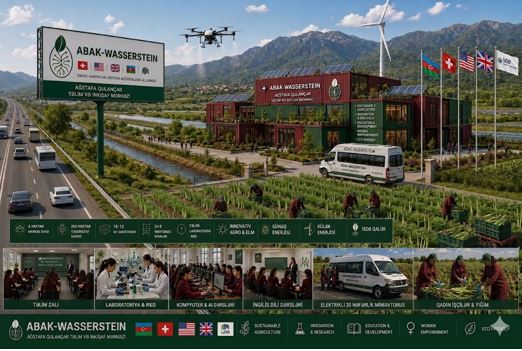
In addition to satisfying the domestic market, we are building a highly qualified “farmership” culture in the regions. We believe that our ABAK-Wasserstein Training and Development Center, which is in the conceptual stage in Aghstafa, and our joint partnership with the Islamic Development Bank (IsDB) will ensure the involvement of women workers and women farmers in innovative agrarian operations on a regional scale. Non-traditional plantations offer a 50% to 300% higher net profit margin per hectare compared to traditional plants, which is a real way out for mass employment in the regions. Particularly, the involvement of women in agrarian projects will significantly fill the unemployment gap in the regions.
– At the meeting, special emphasis was placed on updating irrigation systems, preserving soil fertility, and applying modern technologies. In the face of climate change and the sharp decrease in water resources, what concrete steps should be taken to protect the agrarian sector?
– Water scarcity and climate change are already at the doorstep on a global level; all countries suffer from this, and each country chooses models suitable for itself to overcome major challenges. We must use modern irrigation methods. The concrete step is the transition to Artificial Intelligence (AI) supported Precision Agriculture. Within the WASSERSTEIN Alliance, we—the AI giants of the US, Switzerland, and the Middle East—are cooperating to build this ecosystem and plan to attract larger-scale AI projects to Azerbaijan through AMEC (“Alliance for Multilateral Economic Cooperation”) located in Switzerland. We aim to establish the foundation of AI Agronomist systems, as well as the analysis of soil salinity, water alkalinity, and microclimate parameters in the fields using space and ground sensors in real-time through artificial intelligence.
The second concrete step is the integration of alternative energy and the “Smart Greenhouse.” By applying a special greenhouse complex concept in the future, we plan to take full control of the “Winter Window” season, which is the most expensive selling period in the global market. These technologies protect soil fertility by minimizing water and energy loss and create an “agrarian shield” against the climate crisis.
– Mr. President noted the importance of improving subsidy mechanisms to increase productivity at the meeting. In your opinion, what work should be done in the direction of farmers’ access to finance, technical provision, and establishment of local industrial processing lines?
– Subsidy and concessional credit mechanisms should focus more on the “innovativeness value and processing/export potential of the product” rather than mass production. Instead of traditional plants that require a lot of water and bring low income, preference should be given to farmers who plant non-traditional and high-tech plants. The Ministry of Agriculture already intends to include asparagus in subsidy programs, which will accelerate the involvement of small farmers in this “long-distance marathon.”
However, the most important step is the establishment of Industrial Processing in the country. Simply selling the product as raw material does not bring big income to the entrepreneur and the country. We are currently holding negotiations with German industrial giants to establish IQF (individual quick freezing) lines, frozen industrial lines, and canning factories in Azerbaijan that meet international standards (GlobalGAP, BRC). Together with our strategic state partners like the Azerbaijan Business Development Fund (ABDF), we must finance such industrial processing centers and the “Contract Farming” model. Holdings should manage the processing and export chain, while the small farmer should be provided with a guaranteed industrial buyer (“off-take”).
– At the meeting, the high agrarian potential of the liberated territories—Karabakh and East Zangezur—was specially emphasized. What is the role of the Zangezur corridor in building modern agrarian infrastructure in these territories, and how should international airports in Karabakh be used in export?
– Karabakh and East Zangezur, as well as Nakhchivan, should be the showcase of Azerbaijan’s agrarian innovation. As the WASSERSTEIN Alliance, we are planning a peanut processing factory project in Jabrayil, in the “Araz Valley Economic Zone Industrial Park,” precisely with this strategic goal. Logistics is the most critical factor when building modern agrarian infrastructure in these territories. The Zangezur Corridor (TRIPP – Trump Route for International Peace and Prosperity) is the symbol of the global success of these projects. Thanks to this fast corridor, which will become fully operational by the end of 2028, premium products harvested from our fields will pass through Nakhchivan and be delivered directly to Turkey’s Mersin port, and from there to Europe. In premium products that spoil quickly like asparagus, the speed from field to shelf increases the price 2-3 times.
Along with this, we must use the capabilities of the international airports built in Karabakh (Fuzuli, Zangilan, Lachin) with special logistical privileges (state-subsidized cargo lines). Thanks to cargo capacities of 3-5 tons and the 3-hour direct flight routes to be opened, it is possible to harvest fresh “Made in Azerbaijan” asparagus from the field early in the morning and place it on the shelves of Gulf (Dubai, Riyadh) or CIS megapolis markets by noon. Granting the status of “Fresh-Cargo Hub” and special tariff concessions to these airports will turn the Karabakh region into a regional agrarian superpower. The effective establishment of this “cold chain” will further increase our advantage.
– President Ilham Aliyev put forward the delivery of agricultural products branded “Made in Azerbaijan” to global markets as an important task. How can we make this brand competitive worldwide, and what is the real picture of international markets?
– The global asparagus market will reach a huge volume of 20 Billion Dollars by 2030 with an annual growth of 8.5%. Currently, the annual demand of only the CIS and Gulf markets is approximately 4,000 tons, and this demand is met with high-logistics products coming from very long distances—Peru and Mexico. The “Made in Azerbaijan” brand has a unique logistical advantage: thanks to our geographical position and our internal zero-tariff zone within the CIS, we outperform Peru and Mexico by 60-70% in logistics costs. We constantly discuss these topics and comparative analyses, as well as all our activities conducted in Azerbaijan, at AZPROMO. This also becomes useful in transferring our experience when attracting new investments to AZPROMO. We believe that the State-Private Sector dialogue and cooperation platform will give the most significant results on this opening path of success.
We do not target only Europe and the Gulf within our project. By using the network and international channels of our leading and traditional global seed and genetics partners from the US, we plan to export premium Azerbaijani asparagus to the internal luxury “off-season” market of China. For the “Made in Azerbaijan” brand to be globally competitive, 100% international certification (GlobalGAP, BRC) must be ensured in our fields, and exports must be insured with the “Pre-Agreed Sales” model.
When we combine the vision of our state and the technological power and sales channels of our international alliance, Azerbaijan’s “Green Gold” will become an indispensable part of the world’s most elite tables in the coming years, from Baku to Geneva, Moscow to Dubai, and Beijing to New York.
– Thank you for the interesting interview.