


Tokyo, 20 January, /AJMEDIA/
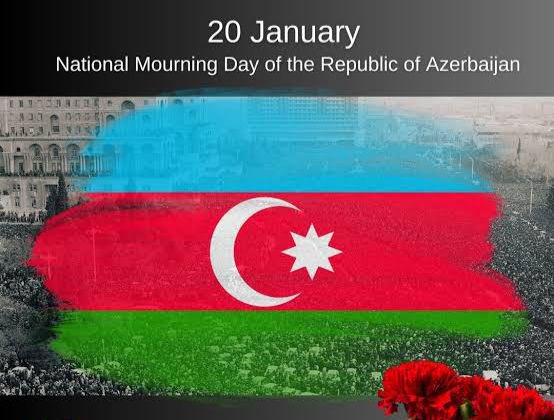
More than 36 years have passed since the January 20 tragedy committed against the Azerbaijani people. This event, which has been engraved in history as “Bloody January”, is one of the most serious crimes committed with the aim of suppressing the desire and desire of our people for freedom. This tragedy has been engraved in the memory of the Azerbaijani people as both a day of sadness and pride. The Bloody January massacre was also an expression of the irrevocable decision of the Azerbaijani people on the path to independence. This history, written with the blood of our martyrs, has become a symbol of the freedom struggle of our people.
January 20 and other tragic events that occurred earlier in the history of Azerbaijan were part of a purposeful policy carried out against our people throughout the 20th century. The separatism that flared up in Karabakh under the auspices of the former Soviet regime, the forced expulsion of Azerbaijanis from their ancestral lands in Armenia, and the genocide committed against our people were an integral part of this policy.
On the orders of Mikhail Gorbachev, the General Secretary of the Communist Party of the Soviet Union, the troops of the USSR Ministry of Defense, the State Security Committee and the Ministry of Internal Affairs were deployed to Baku and several regions of Azerbaijan on the night of January 19-20, 1990. The killing and wounding of hundreds of innocent people as a result of armed aggression against the civilian population once again demonstrated to the world the criminal nature of the totalitarian Soviet regime. The entry of Soviet troops into Baku was accompanied by special cruelty and unprecedented brutality. Even before the state of emergency was declared, 82 civilians had been killed and 20 were seriously injured. This proved that the regime did not ignore any human values in order to drown the people’s desire for freedom in blood.
That night, by order of the Soviet leadership, a 65,000-strong military force, mainly soldiers and officers of Armenian origin, armed with feelings of hostility towards the Azerbaijani people, entered the city from five directions without any warning. Tanks and armored vehicles crushed cars and people in front of them, firing at everyone without them noticing. On January 20 and the next few days, a total of 147 people were killed in Baku, Neftchala and Lankaran, 744 were injured, and more than 800 people were arrested.
The report of experts from the international human rights organization “Shit” on the scale of the tragedy noted: “People were shot with particular cruelty and at close range. For example, Y. Meyerovich was shot 21 times, D. Khanmammadov more than 10 times, and R. Rustamov 23 times. Hospitals and “ambulance” vehicles were fired at, doctors were killed; people were killed with bayonets and knives. Among them was B. Yefimtsev, who had both eyes taken out; 5.45 caliber bullets with a changing center of gravity from the “Kalashnikov” machine gun were used.”
There are thousands of living witnesses to that terrible tragedy that our people faced. One of the most impressive evidences reflecting the grave consequences of the war crime committed by the troops of the Soviet empire in Azerbaijan and at the same time the indestructibility of our people are the photographs reflecting that period. These pictures depicting the blood-soaked Baku night, the bodies of innocent people lying on the streets, and the crowd at the funeral of the martyrs once again bring to mind the pain and suffering of those days.
January 20 is written in the history of Azerbaijan as both a tragedy and a heroic chronicle. The crowd at the funeral of the martyrs showed the whole world the deep sorrow experienced by our people, as well as its national unity, how closely it was able to unite for a common cause. The photographs that immortalize these moments reflect both the difficult and proud pages of our history.
As the Great Leader Heydar Aliyev noted, over time, we understand the importance of January 20 in our history more clearly. On January 20, 1990, the Azerbaijani people gave their first martyrs in the struggle for freedom and independence. Our heroes, who sacrificed their lives, opened a new page in the glorious history of our people with their unparalleled dedication on the path to freedom. One of the most important moments of this tragedy was the victory of the unity of the people and the national will over the power of the empire.
Today, the souls of the martyrs who were killed during that tragedy are happy, because their blood shed at that time was not in vain. The difficult and glorious path that began thirty-six years ago led our people to state independence on October 18, 1991. As a result of the great Karabakh Victory won in the 44-day Patriotic War in 2020 and the anti-terrorist measures carried out in September 2023, the territorial integrity and sovereignty of our country were fully restored. It is for this reason that our people celebrate the 36th anniversary of the January 20 tragedy with special pride and honor.
Over time, the view of the events of Bloody January takes on a broader meaning. If we once commemorated this tragedy with deep sadness and found solace by laying carnations on the graves of martyrs, today we approach those moments with great joy and pride. That cold winter night, when people with disabilities were shot from head to toe by heavily armed Soviet soldiers and crushed under tanks, was, in fact, the first big step our people took on the path of freedom and independence.
After the tragedy, Azerbaijan was subjected to a complete information blockade. This information blockade was supported by the Great Leader Heydar Aliyev, who was living in Moscow at that time. The morning of the tragedy – on January 21, Heydar Aliyev, together with his family members, came to the permanent representation of Azerbaijan in Moscow and demonstrated solidarity with his native people, expressed his sharp protest against this bloody operation committed by the USSR leadership. Stating that the events that took place in Azerbaijan were contrary to law, democracy, and humanism, he raised his voice of protest against this bloody crime. As a result of our Great Leader’s statement on the January 20 events, the world learned about this terrible, particularly ruthless state terror committed by the USSR leadership against the Azerbaijani people.
On November 20 of the same year, at the session of the Supreme Assembly of the Nakhchivan Autonomous Republic, Heydar Aliyev assessed the January 20 tragedy as an aggression against the sovereign rights of the Azerbaijani people. He noted in his speech: “I believe that this tragedy that occurred on January 19-20 is both the result of the great sin of the political leadership of the Soviet Union, personally Gorbachev, a situation that arose from his dictatorial tendencies, and at the same time, the result of the betrayal and crime of the Azerbaijani leaders against the people… This is a military aggression against the Azerbaijani people, an insult, a crime against the Azerbaijani people.” On November 21, the Supreme Assembly of the Nakhchivan Autonomous Republic adopted a document that for the first time gave a political and legal assessment of the January 20 tragedy and embodied the general opinion of our people.
The blood of a martyr is sacred. The most accurate assessment of it was given by the National Leader Heydar Aliyev: “In every drop of that blood there is the power of our people, there is the heroism of our people, there are the dreams of our people for national freedom and independence. The blood shed that night is sacred blood. It is the blood that has joined the blood that our people have shed for centuries for national freedom and independence, the blood shed that night is the blood on our national flag that demonstrates the independence of Azerbaijan.”
The foundation of the path of freedom and victory of the Azerbaijani people was laid precisely on the night of January 20. During this period, Azerbaijan has passed an unparalleled path of development and has become an influential state both in the region and in the world. Our independence has acquired an eternal and irrevocable character. Although time has passed, the only thing that has not changed is the respect and reverence that our people show to the martyrs.
After January 20, the Alley of Martyrs has become one of the sacred pilgrimage sites of our people. This sacred place, located on one of the highest points of Baku, is a symbol of both national sadness and grief, as well as the struggle and invincible will of our people. Over the years, respect for the martyrs has become even stronger. Because it was precisely as a result of their sacrifice that our people achieved their desire for freedom. Also, our Karabakh was liberated from occupation precisely at the cost of the lives and blood of our heroic martyrs. Today, the National Flag of Azerbaijan waves with great pride in every corner of our country. For this, we are indebted to our brave Army, the heroic Azerbaijani soldier and all our martyrs.
Vugar Aghayev